June 1, 2026 • Yuki Brennan • 9 min reading time • Prices verified June 18, 2026
Crib Tents for Climbing Babies: Safety Trade-Offs Every Parent Should Read First
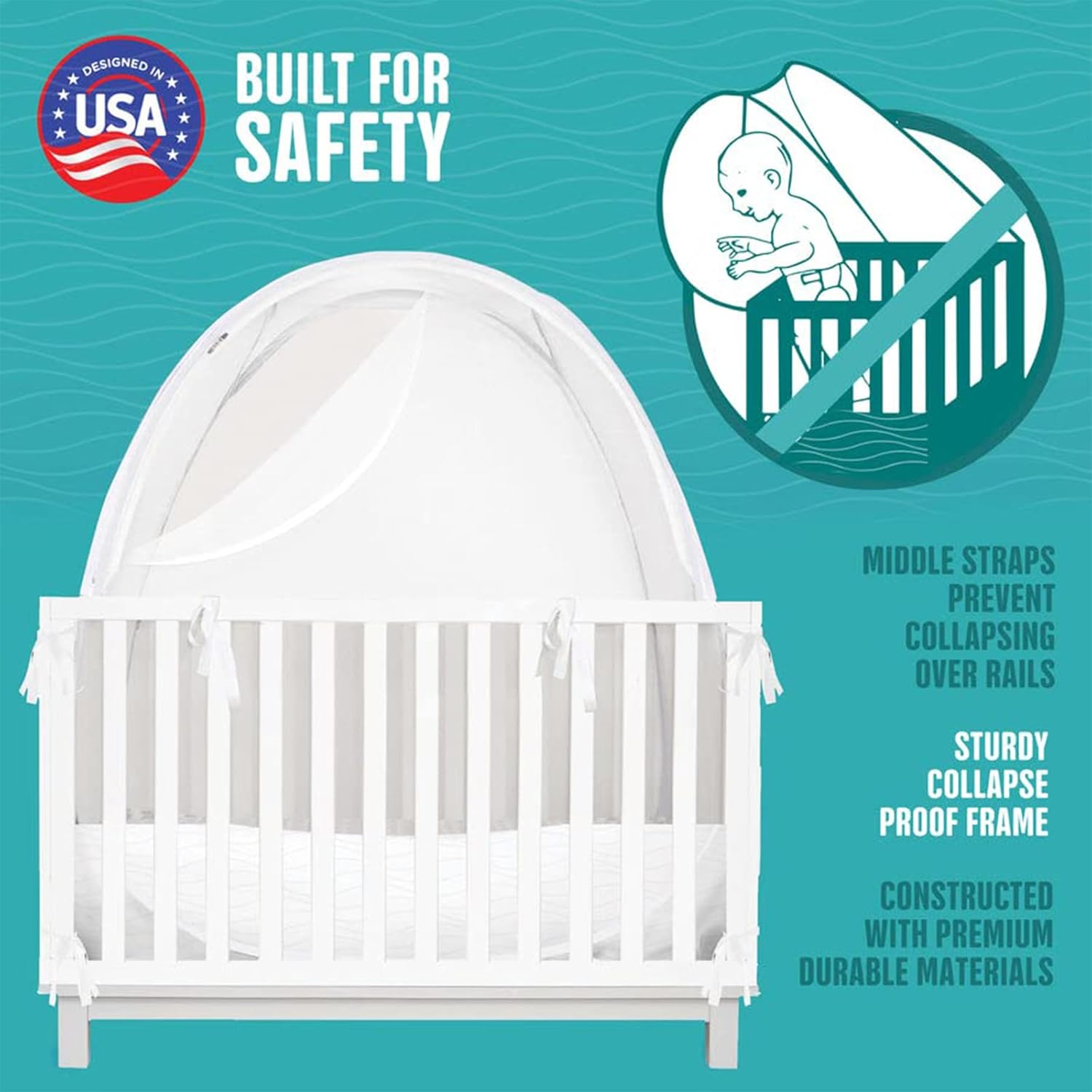
If your baby has recently discovered they can pull to a stand inside the crib — and started treating the top rail like a finish line — you’re probably searching for anything that buys you more time before the full crib-to-toddler-bed transition. A crib tent (a mesh or fabric canopy that zips or clips over the top of a standard crib, creating a covered enclosure) sounds like an elegant solution: keep the baby in the crib, skip the chaotic early-toddler sleep regression, done. But before you add one to your cart, there are some real safety trade-offs that deserve a clear-eyed look. This guide will walk you through what crib tents actually are, where the legitimate concerns come from, what the regulatory picture looks like as of mid-2026, and — critically — what your decision actually comes down to at the end of the day.
What the Safety Agencies Actually Say (and What They Don’t)
Let’s start with the regulatory reality, because it’s messier than most product listings acknowledge.
The U.S. Consumer Product Safety Commission (CPSC) — the federal agency that sets mandatory safety standards for infant sleep products — does not currently have a specific federal safety standard for crib tents as a product category. That’s not a green light; it’s a gap. Per the CPSC’s published crib safety guidance, the agency’s core position is that a baby’s sleep environment should be a firm, flat mattress inside a crib that meets current federal standards, with nothing else in or over the sleep space that could create an entrapment or strangulation hazard. Crib tents, which add structure and fabric directly over and around the sleep area, exist in a gray zone that the CPSC has not explicitly cleared.
The American Academy of Pediatrics (AAP) — the professional medical organization whose safe-sleep guidelines are the de facto standard most pediatricians reference — takes a harder line. The AAP’s safe-sleep guidance, last substantially updated in 2022 and carried forward through their HealthyChildren.org resource library, recommends against adding any soft objects, fabric accessories, or aftermarket attachments to the crib sleep environment. The concern isn’t theoretical: there have been documented incidents — including at least one widely-cited case from the early 2010s that contributed to a major voluntary recall — in which crib tent hardware or mesh created entrapment risk when a child became caught in the zipper mechanism or between the tent frame and the crib rail.
Consumer Reports’ crib buying guide notes that crib tents have historically been a category with inconsistent quality control, and that parents should approach any product in this space with particular scrutiny of construction and hardware attachment points.
The bottom line from the agencies: No crib tent has received affirmative AAP endorsement. None currently carry CPSC mandatory-standard compliance for this specific use case. That doesn’t mean every product on the market is dangerous — it means the safety validation layer that exists for, say, a new crib or a CPSC-certified baby monitor does not exist for crib tents in the same way.
The Real Risk Scenarios (So You Can Evaluate, Not Just Worry)
Understanding why the safety concerns exist helps you think through whether they apply to your specific situation — and whether any mitigation is realistic.
Entrapment at the zipper or frame. Most crib tents use a zippered opening for parent access. If the zipper slides or a toddler learns to partially operate it, there’s a documented risk of a child getting a limb, neck, or head caught between the zipper mechanism and the crib rail. This is the scenario that drove the largest voluntary market recall in this category.
Climbing into, not just out of. A determined climbing toddler who figures out the tent can pull or push on the mesh may actually create new instability — yanking on the canopy frame, destabilizing the crib, or creating a scenario where the tent partially detaches and creates a fabric entrapment hazard. Parents.com has reported on cases where the product solved the climbing-out problem while introducing a new climbing-and-pulling-on-the-structure problem.
Mesh integrity over time. Budget-tier products in this category frequently use lighter mesh that degrades with aggressive chewing, pulling, and washing. A small tear in tent mesh is a potential finger-entrapment point. This is one place where the quality difference between a well-reviewed, purpose-built product and a low-cost generic matters considerably.
Ventilation concerns. Any canopy over a sleep space changes the airflow environment. For most healthy toddlers this is not a clinical issue, but it is a reason to avoid single-layer, non-breathable fabric options and to stick with open-weave mesh designs rated for adequate ventilation.
By the Numbers
| Factor | Detail |
|---|---|
| Age crib-climbing typically begins | 18–24 months (some children as early as 15 months) |
| Average age of toddler-bed transition | 2.5–3 years, per What to Expect’s sleep transition guidance |
| Window crib tent would theoretically cover | ~6–18 months depending on child development |
| CPSC mandatory product standard for crib tents | None (as of May 2026) |
That 6-to-18-month window is worth sitting with. If your child is 22 months and a dedicated climber, you may have 6–12 months before the toddler bed transition becomes appropriate on developmental grounds anyway. That changes the cost-benefit calculus.
The Decision Framework: If X, Then Y
This is where the decision actually lives — not in the abstract safety debate, but in your specific situation. Here’s how to think through it:
If your child is under 18 months and has started pulling to stand but not yet attempting to climb over the rail: The AAP and most pediatricians would recommend holding on the crib tent and instead focusing on whether the mattress height is at its lowest setting (which should push back the attempted-exit timeline meaningfully), and consulting your pediatrician about sleep environment first. The risk-benefit ratio for adding an unvalidated product to the sleep space is harder to justify at this age.
If your child is 18–24+ months, has definitively cleared the rail at least once, and you are not developmentally ready for the toddler bed transition: This is the actual target scenario for crib tents, and it’s where parents most often conclude the transition-delay benefit is worth carefully managed risk. If you proceed, the research points toward a short list of due-diligence steps:
- Choose products with documented, accessible customer safety records — not unbranded generics. Aggregated reviewer feedback on platforms with verified purchases consistently flags hardware quality as the make-or-break variable.
- Inspect the zipper and frame attachment hardware physically before first use and weekly after.
- Do not use any tent with visible mesh tears, frame deformation, or zipper irregularities.
- Ensure the specific crib model is within the tent manufacturer’s stated compatibility range — an ill-fitting tent is a significantly more dangerous tent.
If you have a toddler who is also a chewer: Crib tent mesh is not designed to be chewed, and no crib tent product in this category carries the OEKO-TEX Standard 100 or GOTS organic certification that safety-conscious nursery buyers typically require for textiles that contact the mouth. This is a meaningful concern. If your child chews crib surfaces aggressively, the tent mesh is likely to become a chew target. That’s a material-safety exposure worth taking seriously before proceeding.
If the toddler bed transition is genuinely possible in the next three months: What to Expect’s guidance on transitioning to a toddler bed notes that most children 2.5 and older adapt to the transition more readily than parents anticipate — particularly when the transition is parent-led and paired with a consistent sleep routine rather than reactive to a crisis. If the transition is near-horizon anyway, the risk of adding an unvalidated accessory to buy 90 days may not be worth it.
What Actually Works as an Alternative
Because this guide would be incomplete without naming the practical alternatives:
Lowering the mattress to the floor position. Many standard cribs allow the mattress support to drop to a position where the rail height-to-mattress surface gap is maximized. For early climbers, this alone has bought parents several additional months per aggregated parent review patterns on sites like BabyGearLab’s crib coverage section.
Transitioning to a floor bed or toddler bed earlier than planned. Counterintuitive, but widely reported: toddlers who were climbing out of the crib often sleep better once transitioned, because the power struggle around containment is removed. The AAP’s guidance does not specify a minimum age for the toddler bed transition — it’s a developmental readiness question, not a fixed calendar milestone.
A dedicated sleep sack with a fitted leg opening. A well-fitted wearable blanket (sleep sack) in the correct size meaningfully impedes the leg-lift-and-swing motion that most crib climbers use. This is low-intervention, zero entrapment risk, and reversible. Parents consistently report this as one of the most underrated tools in this scenario. Look for OEKO-TEX certified options from makers like Woolino, Ergobaby, or Halo — all of whom publish their certification documentation.
The Honest Bottom Line
Crib tents occupy an uncomfortable space: they address a real problem (the climbing toddler) with a solution that the relevant safety agencies have not validated and that carries documented risk scenarios. That doesn’t make them categorically off-limits — it means the decision requires more active due diligence than a product with a clean CPSC-standard certification or AAP endorsement behind it.
The parents who come out of this decision in the best position are the ones who go in with clear eyes: they know what the agencies say (no formal clearance), they know what the failure modes look like (entrapment at hardware, mesh degradation, instability), they’ve confirmed their specific crib model is compatible, and they’ve genuinely weighed whether the transition-to-toddler-bed is closer than their anxiety about it suggests.
If your climber is 22 months old, has cleared the rail twice, and you need three more months to prepare — that’s a different calculation than if your 15-month-old just pulled to stand for the first time. Name the actual scenario, apply the framework, and make the call that fits your child’s development and your risk tolerance. That’s the only answer that’s actually yours to make.