April 25, 2026 • Yuki Brennan • 9 min reading time • Prices verified June 18, 2026
Mesh Liner or Silicone Rail Guard? Choosing the Right Crib Teething Protection
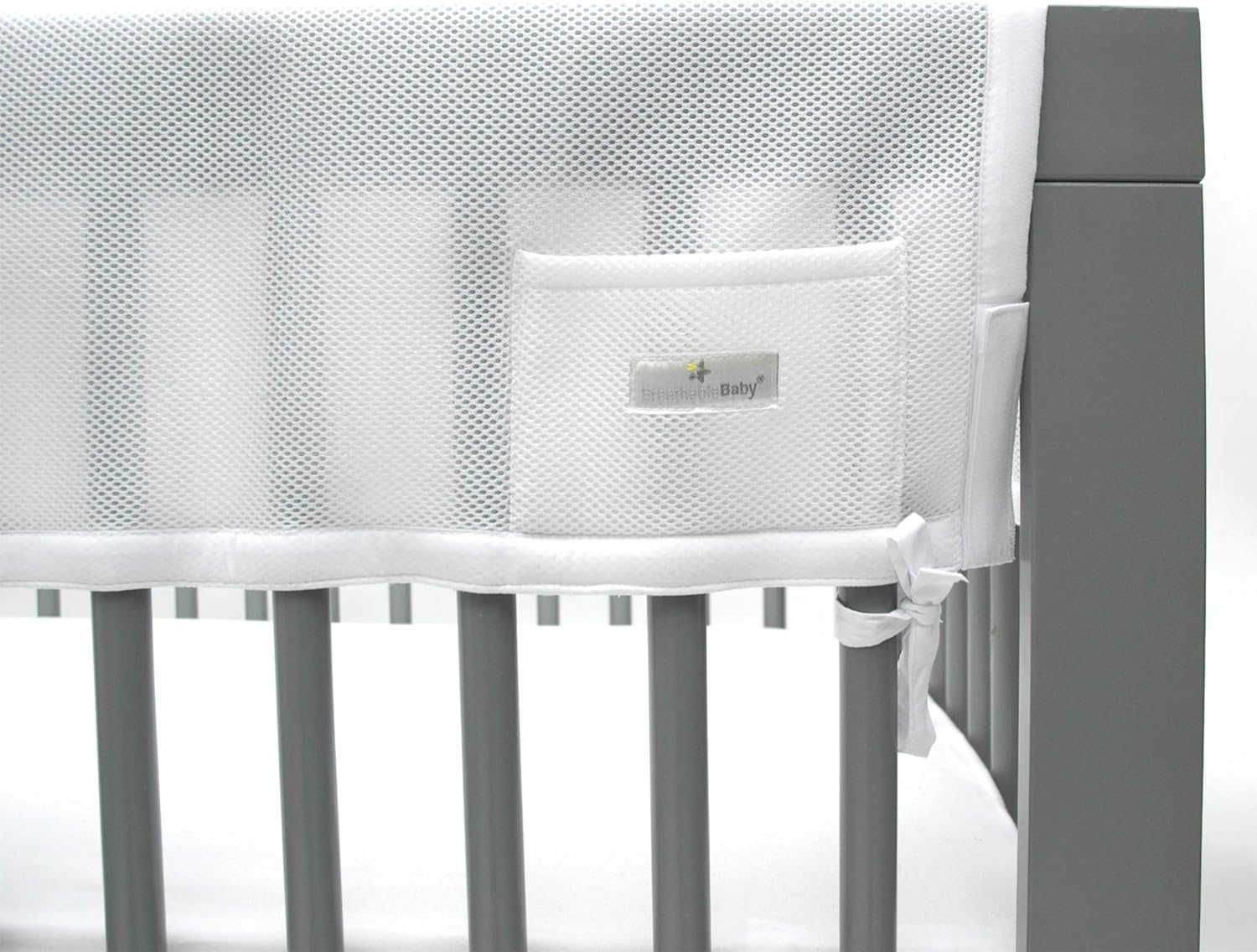
If you have noticed fresh tooth marks on your baby’s crib rail — those little half-moon divots pressed into the wood — you are in good company. The moment babies can pull themselves upright, the crib rail becomes a very convenient chew toy. Beyond the cosmetic damage, the real concern is what those finishes and bare wood splinters might mean for a tiny person who puts everything in their mouth. That’s where crib teething protection comes in: covers or guards that sit between your baby’s gums and the raw rail. Two formats dominate the market right now — mesh liners (breathable fabric panels that wrap the full interior of the crib) and silicone rail guards (flexible rubber strips that clamp or tie directly onto the top rail). This guide breaks down how they differ, where each format wins, and how to match the right choice to your specific situation — whether your priority is material certification, nursery aesthetics, or surviving a world-class chomper.
What Each Format Actually Is (and Does)
Before comparing them side by side, it helps to understand what problem each product was originally designed to solve — because they started from different intentions and have only recently overlapped as “teething protection.”
Mesh liners grew out of the old crib-bumper category. Traditional padded bumpers were phased out of mainstream retail after the American Academy of Pediatrics, via their guidance published on HealthyChildren.org, consistently reinforced that soft, padded crib bumpers pose suffocation and entrapment risks for infants under 12 months. Mesh liners emerged as the safety-conscious replacement: thin, breathable panels — usually made from polyester mesh or OEKO-TEX–certified cotton muslin — that line the inside perimeter of the crib. They protect the rail, yes, but they also act as a visual softener for the crib interior and can prevent little arms and legs from slipping through the slats. Brands like Aden + Anais and Breathable Baby built their reputations in this category.
Silicone rail guards are purpose-built chew protection, full stop. They are narrow strips — typically 2–4 inches wide — made from food-grade silicone (the same class of material used in infant pacifiers and bottle nipples) that attach along the top rail and, in some designs, along the front top rail corner where chewing is most concentrated. Loulou Lollipop is the most-cited premium name in this segment. Because they cover a much smaller surface area than a mesh liner, they do nothing for the overall crib aesthetic the way a fabric liner does — but they are exceptionally durable and easy to sanitize.
The Side-by-Side That Actually Matters
Here is where the decision gets real. The two formats are not competing for the same job in the same way.
Coverage and placement
A mesh liner wraps the full interior of the crib — all four sides, floor to midpoint roughly — which means it intercepts chewing wherever it happens: the long side rails, the short end rails, and the slat faces. This matters because babies are not predictable. Reviewers on BabyGearLab note that once a baby discovers chewing, they work the whole perimeter, not just the top of the front rail.
A silicone guard covers only the specific rail sections you attach it to. Most kits include one or two strips sized for the top rail of a standard crib. If your baby is a full-perimeter chewer, you may need multiple guards, and compatibility gets complicated fast. The Pottery Barn Kids Larkin crib, for example, has a top rail profile that differs enough from an IKEA Sundvik that not every guard strap system fits cleanly — always verify slat-to-rail dimensions before purchasing.
Material safety and certification
This is the segment of the comparison where the decision often gets made for safety-first families.
OEKO-TEX STANDARD 100 (a third-party certification that tests every component of a textile — including thread, dyes, and hardware — for harmful substance limits appropriate for infant contact) is the baseline certification worth looking for in a mesh liner. GOTS (Global Organic Textile Standard) goes further, covering both environmental and social criteria in the supply chain on top of the substance testing. Aden + Anais, whose muslin products carry OEKO-TEX certification per the OEKO-TEX Association’s public certification database, is a common reference point for parents in this comparison.
For silicone guards, the relevant standard is food-grade silicone — silicone that has passed regulatory standards (in the U.S., relevant to FDA 21 CFR guidelines for food-contact materials) for use in items that will be repeatedly mouthed. Loulou Lollipop markets its guards as food-grade silicone, and that claim is worth verifying against the brand’s published documentation before purchase. What to Expect’s product editorial notes that buyers should look specifically for that “food-grade” language on silicone teething products rather than assuming all silicone is equivalent.
Neither format has an automatic safety advantage — a poorly certified fabric liner with undisclosed dyes is more concerning than a well-certified silicone guard, and vice versa. The certification, not the material category, is the reliable proxy.
Chew intensity and durability
Here is where the formats diverge most sharply.
| Format | Light-to-moderate chewing | Aggressive, sustained chewing |
|---|---|---|
| Mesh / fabric liner | Holds up well; easy to wash | May show fabric pilling, thin spots over 6–12 months |
| Silicone rail guard | Adequate | Significantly more durable; resists puncture |
Good Housekeeping’s guide to crib rail guards observes that parents of aggressive chewers consistently report that fabric covers — even reinforced muslin — show wear within a few months of heavy use, while silicone guards from established brands show minimal surface degradation across the same period. That tracking aligns with what aggregated owner reviews reflect: fabric is a comfort and aesthetics upgrade for typical teethers; silicone is the answer when your baby means serious business.
Aesthetics and nursery fit
Let’s be direct: a silicone guard, in any colorway, is a visible piece of protective equipment. The best ones — Loulou Lollipop’s sage green or blush tones, for instance — are thoughtfully designed, but they read as an accessory addition to the crib. A mesh liner, by contrast, integrates into the crib’s visual interior and can carry a textile story (solid white, printed muslin, natural oat) that ties to your bedding or wall palette.
For nurseries built around a defined color scheme, this is not a trivial point. Design-conscious parents who have spent time sourcing the right fitted sheet to match their wallpaper frequently report that a mesh liner feels like a continuation of that intention, while a silicone guard feels like an interruption of it. Neither is wrong — they serve different priorities.
Installation, fit, and compatibility
Mesh liners typically tie onto crib slats with fabric ties and are sized to standard-slat-count cribs. Most are designed for cribs with standard American rail heights. Compatibility issues arise with non-standard European crib profiles or convertible cribs whose rail geometry changes when the mattress drops to a lower position.
Silicone guards clamp or strap over the rail and are highly sensitive to rail width. A guard sized for a 2-inch rail will gap or slip on a 1.5-inch rail. Before purchasing, measure the width of the top rail’s chewable face and compare it to the guard’s listed fit range. Several Mushie-adjacent boutique brands now publish fit guides by crib model — worth referencing before committing.
By the Numbers
- Mesh liner price range: $30–$80 for full-crib sets (Aden + Anais, Breathable Baby)
- Silicone guard price range: $25–$60 per strip or two-pack; premium sets (Loulou Lollipop) run $80–$150 for full-rail kits
- Typical replacement interval (fabric): 6–12 months for aggressive chewers; 18–24 months for light use
- Typical replacement interval (silicone): 18–36 months reported by owners in long-run reviews
Cost-per-month math tends to favor silicone for families with documented aggressive chewers: a $90 silicone kit lasting 30 months is $3/month versus a $45 mesh liner replaced every 8 months at $5.60/month.
The Decision Framework: If X, Then Y
After absorbing all of the above, most decisions reduce to a small set of conditional rules. Here is the clear version:
If your baby is a light-to-moderate chewer and nursery aesthetics are a priority → a certified mesh liner (OEKO-TEX or GOTS) is your natural fit. It integrates visually, handles normal teething, and washes easily. Start with Aden + Anais or a similar muslin-based option with a documented certification.
If your baby is an aggressive, sustained chewer and durability is the non-negotiable → food-grade silicone is the more cost-effective long-term choice. Verify the “food-grade” claim in the brand’s published materials, measure your rail width precisely, and accept that the guard will be visible.
If material certification is your first filter and you’re still deciding on format → both formats can meet a high bar, but the burden of proof is on the buyer. For fabric, look for OEKO-TEX STANDARD 100 or GOTS on the product page or the OEKO-TEX Association’s public certification lookup. For silicone, look for food-grade designation and, ideally, a reference to the applicable regulatory standard.
If you have a non-standard or boutique crib model → measure before buying either format. Mesh liners with standard tie systems are more forgiving of unusual dimensions; silicone guards are less so and require the rail-width verification step.
If you want a gift that photographs well and signals thoughtfulness → a premium mesh liner in a coordinated colorway from a brand like Aden + Anais or a similar boutique maker lands better as a gift than a silicone guard, which reads as more utilitarian on a registry.
A Note on What Certification Claims Are Worth
The U.S. Consumer Product Safety Commission’s crib safety guidance (published on CPSC.gov) does not specifically regulate crib teething covers as a product class, which means no federal safety standard exists specifically for these items — the vetting falls to the buyer. Third-party certifications like OEKO-TEX STANDARD 100 are meaningful because they involve actual substance testing by an accredited laboratory, not a brand’s self-declaration. When a product page says only “non-toxic” with no named certifying body, that phrase carries no enforceable meaning. Treat named third-party certifications as the floor, not a bonus feature.
This gap in regulation is exactly why the certification conversation matters more in this product category than in almost any other nursery purchase. Your baby will put this object in their mouth, repeatedly, for months. The extra ten minutes spent verifying a certification label is the most useful research you can do before any other comparison.
Both formats have earned their place in the nursery. The mesh liner is the warmer, more design-integrated choice for typical teething. The silicone guard is the more durable answer for serious chewers. Neither is inherently safer than the other — that comes down entirely to what’s in the material and who has verified it. Know your baby’s chewing intensity, know your crib’s dimensions, and demand the certification documentation. The rest is style.